miércoles, 13 de noviembre de 2013

Are You Prepared to Enter the Yoga Matrix? An Interview with Richard Freeman

Richard Freeman is one of the West's most respected teachers of ashtanga yoga. At his popular Yoga Workshop school in Boulder, Colorado, he follows the traditional approach of his teacher, K. Pattabhi Jois of Mysore, India, in emphasizing the philosophy of yoga, as well as mastery of the asanas (postures) we more commonly associate with its practice. Here Richard discusses the “yoga matrix,” a foundation of the philosophy that unites the many different schools of yoga. Source Soundstrue.com

Sounds True: Your new teaching program is called The Yoga Matrix. What is the meaning of this term?
Richard Freeman: Well, by “matrix” we mean “context”—the ground from which things are born which envelops them and penetrates them. When we refer to “the yoga matrix,” then, we're talking about an awakening awareness of the context from which all of our immediate experience arises, and the deeper process of the mind revealed as we practice yoga.
Sounds True: And by “yoga,” you mean ...
Richard Freeman: In our philosophy, yoga is the observation of the inner depths of the body, the breath, and the mind, and their complete release in the experience of freedom. By “freedom” I mean the ability to experience the full, open spectrum of life without contraction or limitation.
Sounds True: On The Yoga Matrix program, you describe achieving this freedom by “opening the core of the body.” Please describe how this process works.
Richard Freeman: Entering the core of the body means insight into the mind in which it is enmeshed. Feelings, sensations, ideas, and emotions that are deep and primordial, that transfigure everything for us, are in the core of the body. Literally we are referring to the central axis of the body, from the middle of the crown of your head, right down through the core of the heart, the roots of the navel, and into the middle of the pelvic floor. The various practices of yoga can open this core from both the inside and the outside. Then the patterns of even simple experiences connect through the core to everything else.
We so often keep this core closed off. We tend to stay out of it because the core is too wonderful, too intelligent and alive. The experience of it might cancel our ego's program for keeping us miserable and alone.
Sounds True: You describe the human body as a “temple” and “place of worship” that is immediately available to each of us. That's not the typical approach to yoga as many of us understand it.
Richard Freeman: The body is much, much more than what we think it is. It's actually a mystery; a fascinating, wonderful manifestation of the entire universe. By learning to pay close, meditative attention to the body's simple sensations, feelings, and mental processes, we can discover the truth about what is sacred and what is immediate in life.
If we look for the sacred only in objects or processes outside of our bodies, we never transform what is most immediate in our experience. We never develop the habit of looking within for what is most significant. I think if people would look at their own bodies as temples, we could relieve much of the conflict in the world over what is and what is not “holy ground.” It would erase a lot of the confusion we have about who we are
and who others are.
Sounds True: You see confusion arising from our lack of connection to our bodies.
Richard Freeman: Right. When someone says they are confused about what's important in life, that person tends to ride their body around as if it were some sort of machine to exploit. They reduce their body to a theory of their body, an object, and then they try to get pleasure out of the body in ways that are uncaring and abusive. Because the mind/body is a matrix we also then reduce others to theories. Is it any surprise that our relationships with others are often exploitative, and less than loving? When we reorient our awareness to see that the body itself is sacred, a place of worship, we stimulate all aspects of our lives in the most beautiful way.
This brings us back to the concept of the matrix, and our mutual interdependence. Nothing that you pull out of a matrix can exist separately. And so we ourselves—our minds and our experiences—do not exist separately from the whole matrix of the universe. Through yoga, we come to the direct realization that we are interlinked with other people—that our cores can't really be illuminated unless we open our hearts to everybody.
Once you take the yogic path, and become aware of the matrix and our interdependence, you manifest a kind of natural love for others. You find that your happiness is really inseparable from the happiness of other people. And when you are able to encompass all other beings within your own heart, then you know that your practice of yoga is really working.

martes, 12 de noviembre de 2013

From the samkhya karika by ishvara krishna

My opinion is that nothing is more modest than the Prakrti: Knowing that "I have been seen", she no more comer within sight of Purusa.
Thus, verily, Purusa is never bound, nor is he released nor does he migrate. (It is the) Prakrti, being the support of manifold creation, that migrates, is bound and is released.
Prakrti by herself binds herself by means of seven forms, and it is she again, who by means of one form, releases herself for the benefit of the spirit.
Thus, from the practice of truth, is produced the wisdom in the form: "I am not", "nothing is mine",  and "not-i", which is final, pure on account of the absence of error, and absolute (knowledge).
By means of this knowledge, the spirit, as a witness, pure and at case, beholds nature, which has ceased from evolving products, and desisted from the seven forms of evolution, under the influence of the purpose of the spirit.
The one (Purusa) thinks: "she has been seen by me" and therefore, loses all interest ; the other (Prakrti) thinks "I have been seen" and ceases to act
further. Therefore, even if there is still connection there is no motive for further evolution.

viernes, 8 de noviembre de 2013

Interview with Matthew Sweeney


Do you think there is any relationship between the three Granthi and diseases such as depression or anxiety?

Matthew: The three Granthi EXPRESS themselves as stress, anxiety, depression, mental illness, physical illness etc etc. It is not possible to separate these concepts. It is also not 'wrong' to have these illnesses - they are your journey, your lesson, and your pathway to make contact with self and the divine. When your system is out of balance, whether mentally or otherwise, the contractions we feel are the three Granthi at work. They are not bad - we contract and resist as a form of balance against greater pain - rightly or wrongly.

What is the main difference between your vinyasa krama sequences and Ashtanga series?

Matthew:Vinyasa Krama is intended as a support to Ashtanga Yoga - not to replace it - rather to enhance it, they allow more people to keep practicing with greater ease and greater joy.

Do you think that ashtanga can be practiced for all live?

Matthew:Some people can practice Ashtanga for most of their lives, most people cannot. They either need to vary the system a little, or change it entirely.

Do you think that after all this years of practicing, you already have found Mula bandha (in the full sense physical / energetic) or you are still looking?

 Matthew:Mula bandha is ultimately a state of mind - freedom from 'lower body' or lower Granthi contraction. I have definitely felt this in my life, through great joy, bliss and surrender to God. But I still feel pain and contraction also - I am human after all.

Thanks a lot Matthew Sweeney


sábado, 2 de noviembre de 2013

The three granthi from the Hatha yoga pradipika

The Brahma granthi being pierced, the feeling of bliss arises from the void;
wondrous, tinkling sounds and the unstruck sound (anahata) are heard
within the body.
When the yogi experiences arambha in the void of the heart, his body
becomes lustrous and brilliant with a divine smell and diseaseless.
In the second stage, when ghata is achieved, the Shakti goes into the middle
nadi. Being fixed in his asana the wise yogi is comparable to a divine being.
When the Vishnu granthi is pierced the greatest bliss is revealed. Then from the
void the sound of the kettledrum manifests.
In the third stage is the experience of the sound of the drum. Then there is the
great void and one enters the place of total perfection or siddhi.
Then the bliss of chitta being attained, natural or spontaneous ecstasy arises.
Imbalance of the three humours or doshas, pain, old age, disease, hunger,
sleep are overcome.
If the Rudra granthi is pierced, the fire of prana moves to the place of
Ishwara. Then in the stage of nishpatti or consummation is the tinkling
sound of the flute resonating like a vina.
This is called raja yoga when there is one element in the mind or chitta. The
yogi becomes Ishwara, being the creator and destroyer.

viernes, 1 de noviembre de 2013

Yoga Sikha Upanishad

Om ! May He protect us both together; may He nourish us both together;May we work conjointly with great energy,May our study be vigorous and effective;May we not mutually dispute (or may we not hate any).Om ! Let there be Peace in me !Let there be Peace in my environment !Let there be Peace in the forces that act on me !

First Chapter
“All the living beings are surrounded by the net of illusion, Oh God, Parameshwara, Oh God of Gods, How will they attain salvation? Be kind enough to tell.” Asked Lord Brahma to Lord Parameshwara and he replied as follows: 1.1

Some people say that the only way out is Jnana (knowledge). To attain occult powers, that alone will not suffice. How can Jnana without Yoga lead to salvation? It is also true
that Yoga alone without Jnana will not lead to salvation. So the one who aims at salvation, should learn Jnana and Yoga together. 1.2


Like a rope ties a bird, the minds of all living beings are tied. Enquiries and researches do not affect the tie of this mind. So the only way to win over this mind is through victory over Prana. There is no other option to get victory over Prana except Yoga and there are no methods except those shown by Siddhas. 1.3

So I am teaching you this Yoga Shika (head of all yogas). It is greater than all Jnanas. After sitting in either Padmasana (lotus position) or any other Asana, and after concentrating the sight to the tip of the nose and after controlling both the hands and legs, meditate on the letter ‘Om’ with a concentrated mind. If one continuously meditates on Parameshwara, he would become an expert in yoga and the Parameshwara would appear before him. 1.4

If we sit in an asana and continuously practice, the bindu will cease from going down. Without Pooraka and Rechaka, the Prana would stand in Kumbhaka for a very long time. You would hear different types of sound. The nectar will start flowing from the place of the moon. Hunger and thirst will cease. Mind would get concentrated on the ever flowing bliss. The four steps for this are Mantra Yoga, Laya Yoga, Hatha Yoga and Raja Yoga. The great Maha Yoga, which is one, has been divided in to four and named as above. The prana goes out with sound “ham” and goes in with the word “sa”, and all beings naturally chant the mantra “Hamsa, Hamsa” (while exhaling and inhaling). This is chanted in the Sushumna after being taught by the Guru in an inverted manner (Hamsa inverted is soham). This chanting of the mantra “Soham, Soham (I am it)” is called Mantra Yoga. Sun is the letter “Ha” and moon is the letter “Tha”. The joining of sun and the moon is the Hatha Yoga. Due to Hatha Yoga, the idiocy which is the cause of all doshas (draw backs) is swallowed. When the merging of Jeevatma and Paramatma takes place, mind melts and vanishes. And only air of Prana remains. This is called Laya Yoga. Because of Laya Yoga that heavenly Swathmananda Sowkhya (the well being of the joy of ones own soul) is attained. In the great temple of the middle of yoni (the female organ) the principle of the Devi, which is red like Hibiscus flower lives as Rajas in all beings. The merger of this rajas with the male principle is called Raja Yoga. As a result of Raja Yoga, the Yogi gets all the occult powers like Anima. You have to understand that all these four types of Yogas are nothing but the merger of Prana, Apana and Samana. 1.5

For all those who have a body, their body is the temple of Shiva. It can give them occult powers. The triangular part in between the anus and penis is called the mooladhara. This is the place where Shiva lives as a life giving force. There the Parashakthi called Kundalani lives. From there wind is produced. The fire is also produced from there. From there only the sound ‘Hamsa’ and the mind are also produced. This place which would give whatever is asked for is called Kamakhya peetam (the seat of passion). In the edge of the anus is the Swadishtana Chakra with six petals. Near the belly is the Mani Poora Chakra with its ten petals. In the place near the heart the Anahatha Chakra with its 12 petals exists. And, Hey Lord Brahma, this is called the Poorna Giri Peeta. In the depression in the throat, Vishudhi Chakra with its 16 petals exists. Hey lord of Lords, that is the Jalandara Chakra. In between the eyelids is the Agna Chakra with its two petals. Over that is the Maha Peeta called Udayana. 1.6


Second Chapter
This world functions because of the unclear foundation power which is described as Maha Maya, Maha Lakshmi, Maha Devi and Maha Saraswathi. That power shines in a micro form as a Bindu (dot) on the Peeta (seat). That Bindu breaks the Peeta and emerges from there in the form of Nadha (sound). That Nadha Brahma assumes three shapes viz., Macro, Micro and external. The macro form is the big shape which is pervaded by the five Brahmans. The micro form which arises from the Nadha with its three Bheejas (roots) is the form of Hiranya Garbha. Para is the ever true property of Satchitananda. By continuously chanting the Atma mantra, the glitter will occur in Para Thathwa (the philosophy of the external). For the Yogi who has stopped his mind, this appears in the micro form similar to the flame of the lamp, moon’s crescent, like a fire fly, like a streak of lightning and like the glitter of stars. There are no greater mantras than Nadha (sound), no Gods greater than Atma, no greater worship than the meditation and no pleasure greater than satisfaction. My devotee who understands this would remain stable in his happiness. To that great man who has great devotion to God as well as similar great devotion to his teacher, all this would be understood automatically.


Third Chapter
That great ever living Nadha (sound) is called Sabhda Brahman. It is the strength residing in the Mooladhara. Para is the foundation for its own self and is of the form of Bindhu. That Nadha coming out of Parashakthi (similar to the germ coming out of the seed) is called Pasyanthi (we see). The Yogis who are able to see using the Pasyanthi Shakthi, understand that it is the whole world. That power produces sound like a rain starting from the heart. Hey Lord of Lords, there it is called Madhyama. It is called Vaikari when it merges in the sound form with Prana and exists in the throat and jaw. It produces all the alphabets from Aa to Ksha. From alphabet words arise and from words rise the sentences and from them all the Vedas and Mantras. This Goddess Saraswathi lives in the cave of intelligence in all beings. In meditation when will power melts, you can reach this Para Thathwa.


Fourth Chapter
Because the divine power is single, there are no differences there. You have to understand that the thought process of living beings is like seeing a snake in a rope. When you do not know, it is a rope and then for a small time the rope appears as a snake. The ordinary intelligence is similar to this. We see everything as the world that we see. There is no reason or basis for this world to be different from this Brahman. So the World is only Brahman and not anything different. If you understand the Para Thathwa like this, where is the cause for differentiation. 4.1

In Taittiriya Upanishad fear has been told as belonging to that foolish person who finds difference between Jeevatma(soul) and Paramatma (God). Though this world has been told as some thing to be experienced, in the next moment it vanishes like a dream. There is no state of waking up in a dream. There is no dream in the state of waking up. Both of them are not there in Laya. Laya is not in both of them. All these three are illusions created by the three characters. The one who sees this would be above characteristics and would be forever. 4.2

The Chaithanya (activity) starts in the form of the world. All these are Brahman. It is useless to differentiate it as Atma and Anatma when dealing with wise people. The foolish man thinks that body is attached to the soul. The belief that pot is mixed with the mud and the water is mixed with mirage and similarly the belief that body is mixed up with the soul is because of taking recourse to ignorance. 4.3


Fifth Chapter


That Yogi who has mastered yoga and who has complete control over his senses would attain whatever he imagines. The Teacher (guru) is the Brahma, He is Vishnu and He is the Lord of Lords Sadashiva and there is nobody greater than the teacher in all the three worlds. We should worship with devotion that Parameshwara, who is the great Soul who has taught us the divine knowledge. The one who worships like that would get the result of Jnana fully. Do not keep your aim because of the wavering mind on occult powers. The one who knows this principle well, is the one who has attained salvation. There is no doubt about it.


Sixth Chapter
That great light in which the Bhoo Loka, Bhuvar Loka and Suvar Loka [Worlds] and the Sun, Moon and Fire Gods, are but a small part in the letter “Om”. When mind wavers, the worldly life and when it is firm, the salvation will result. So Lord Brahma, using great intelligence we have to keep the mind not to waver. For desire to posses wealth, the mind is the reason. When that is destroyed, the world would be destroyed. One should with lot of effort start the treatment for that. When a man looks after his mind using his mind and realizes that it has stopped running, he would see the Parabrahman, which is very difficult to see. The Yogi is able to get salvation by seeing his mind with his mind. We have to see the mind with the mind and hanker for that mad state. We have to see the mind with the mind and be stable in Yoga. 6.1

In any place where the wind moves, the mind also wavers. Mind is called moon, sun, wind, sight and fire. The Bindu(dot), Nadha (sound) and the Kala (crescent) are the Gods Vishnu, Brahma and Ishwara. By constant practice of Nadha, the bad influences will vanish. That which is Nadha becomes the Bindu and then becomes the mind. One has to clearly aim at the unification of Nadha, Bindu and Chintha. Mind itself is the Bindu and that is the reason for the state of creation of the world. Similar to milk being produced by the cow, Bindu is produced by the mind. 6.2

The one who realizes well the six wheels (Agna chakras) enters the world of pleasure. One has to enter it by controlling the airs in the body. One has to send the air (Vayu) upwards. One has to practice Vayu, Bindu Chakra and Chintha. Once the Yogi realizes Samadhi by one of them, he feels that everything is nectar like. Similar to the fact that the fire inside the wood cannot be brought out without churning it by another wood, without practice, the lamp of wisdom can not be lit. Adopting his teacher as the one who pilots the ship and by adopting his teachings as the stable ship, with the power of constant practice, one crosses the sea of this birth. Thus tells this Upanishad.


Om ! May He protect us both together; may He nourish us both together;May we work conjointly with great energy,May our study be vigorous and effective;May we not mutually dispute (or may we not hate any).Om ! Let there be Peace in me !Let there be Peace in my environment !Let there be Peace in the forces that act on me !
Here ends the Yoga-Sikhopanishad belonging to the Krishna-Yajur-Veda.


Translated by P. R. Ramachander

jueves, 31 de octubre de 2013

The three gunas from the Bhagavad Gita


Know thou Rajas to be of the nature of passion, the source of thirst (for sensual

enjoyment) and attachment; it binds fast, O Arjuna, the embodied one by attachment to action!

But know thou Tamas to be born of ignorance, deluding all embodied beings; it binds fast,

O Arjuna, by heedlessness, sleep and indolence!

Sattwa attaches to happiness, Rajas to action, O Arjuna, while Tamas, shrouding


knowledge, attaches to heedlessness only!

Now Sattwa prevails, O Arjuna, having overpowered Rajas and Tamas; now Rajas,

having overpowered Sattwa and Tamas; and now Tamas, having overpowered Sattwa and Rajas!

When, through every gate (sense) in this body, the wisdom-light shines, then it may be

known that Sattwa is predominant.

Greed, activity, the undertaking of actions, restlessness, longing—these arise when

Rajas is predominant, O Arjuna!

Darkness, inertness, heedlessness and delusion—these arise when Tamas is

predominant, O Arjuna!

miércoles, 30 de octubre de 2013

Food for intense ashtanga practice by Anthony Gary Lopedota

http://ashtangayogatherapy.wordpress.com/2013/10/21/food-for-intense-ashtanga-practice/


Finding Mula Bandha. ~ Toni Romero


That which is the root of all beings,
that root which bonds all of the mind
(all thought and experience)
That is , which should always be served
attended to) and which is fit for rajayogins.
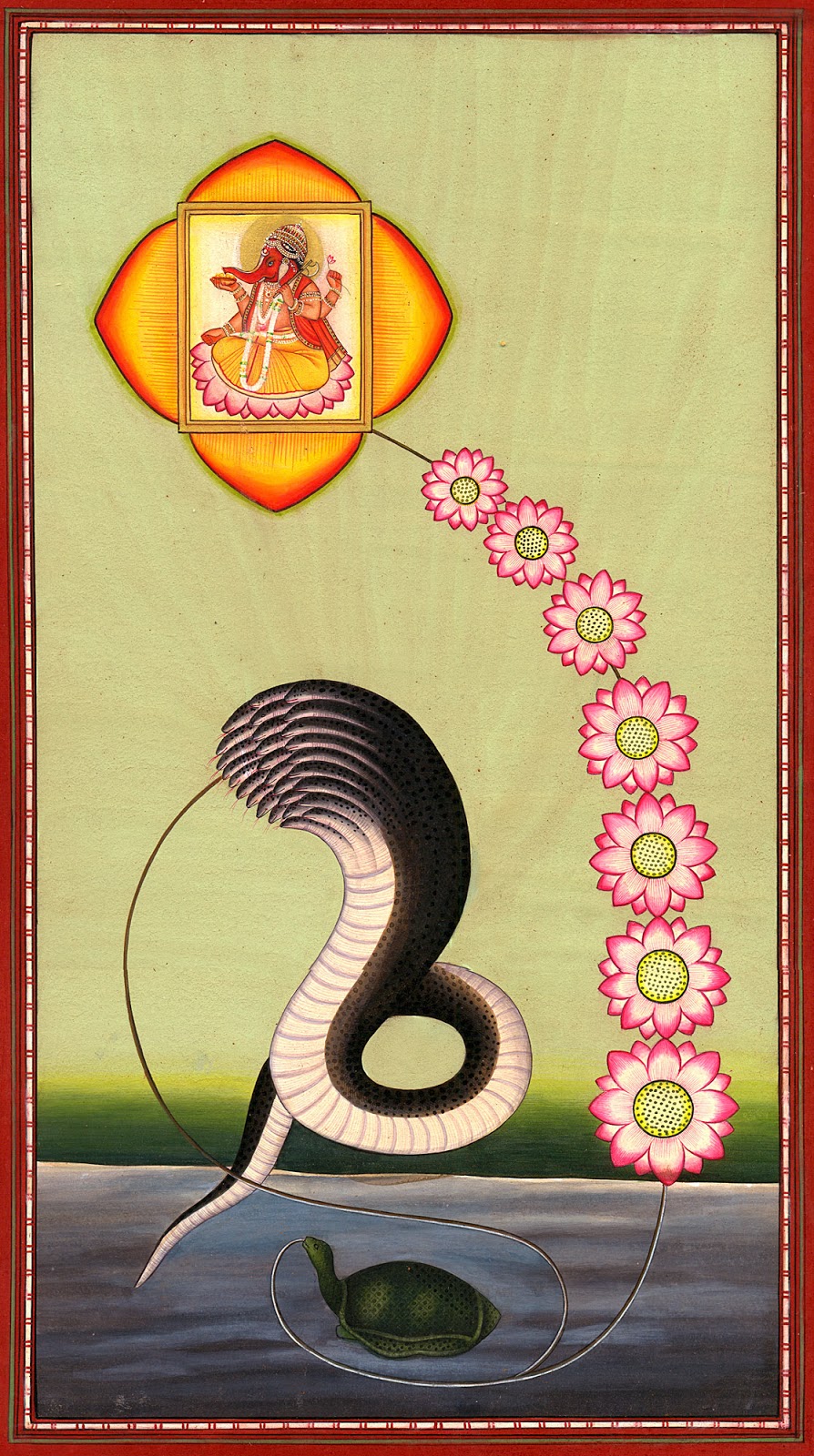
Ganesha Lord of Mula Bandha


~ Sri Shankaracharya


Mula bandha is the gate that moves from the physical to the subtle.

Learning to understand all of this intelligence takes many years. These simple notes are the result of learning from several sources and daily practice. With all the humility, I hope it will be useful to people who read it.

The first point is try to create mula bandha in the physical sense. Hatha Yoga Pradipika and other classical texts define mula bandha as heel pressure directly on the perineum.

Positions like siddhasana are a good starting point to begin to feel the area between the genitals and anus (pelvic floor). The intention is to create a tension in that muscle group and lift it upwards as if it were a flame that lights just that intermediate point and rises. At the beginning, it is near impossible; it is almost instinctive and easier contract the anus (Aswini mudra).

To distinguish different muscle tones, it is recommended to practice Kegel exercises in which you are using what is called the pubococcygeus (PC) muscle. It is the muscle used when the action of urination is interrupted. This allows us define two starting points from the front and back (PC muscle and anus). If we try to visualize a rhomb in this area and add the left and right buttock, then we have four corners that draw the gross surface where the pelvic floor is contracted.

To put mula bandha into practice at first, the recommendation is to contract the three points and try to visualize the left and right gluts coming together into a compact group of muscles. Once you locate the point in between the anus and the genitals, there is an interesting lack of tension in the anus. When you feel mula bandha, the apana is drawn upwards.

Prana vayu and apana vayu are two of the five types of vayu that form the Prana, which is translates to vital energy. As prana vayu moves up into the chest area, the seed point is at the center of the chest. When you take a maximum inhale, the chest expands and grows. This is the most pranic stage of the breath.

Apana vayu moves down the lower body. The seed point is in the center of the pelvic floor. Precisely as you exhale, contract your abdominal muscles while the chest is closed. Prana is like flying in the sky and apana is like a root in the earth. This is the importance of mula (root) bandha (seal). Their function is to reverse the movement of apana and ascend upward. Thus the height of the pubic bone and the prana apana are pressed into each other.

Some versions say that heat kills kundalini and releases it into the entrance of the central nadi (sushumna). Then prana can rise freely and lead Shakti (creative energy) to join the universal consciousness Shiva. There are several variations of the process, depending on different lineages, which I will not extend at this point as it is a very extensive subject.

A good way to feel the contraction that occurs in the pelvic floor when turning to prana and apana is to try exhaling completely, keeping the chest open to maintain the residual quality of inhalation (postural and energetically). During the exhale, reach the point of expelling the air until there is one final breath through the nose. Make a “puff” sound (like Richard Freeman explain in his pranayama course). At that time, if you direct your attention with great delicacy and practice, you will feel a slight contraction between the anus and genitals. Try to keep that soft and subtle tone when inhaling, maintaining residual quality of the out breath in the inhalation. Bring the attention of inhalation as a thin flame that comes from the pelvic floor and rises through Sushumna Nadi.
Other devotees offer as sacrifice the incoming breath of prana in the outgoing breath of apana, and the outgoing breath of apana in the incoming breath of prana, thus arresting the cause of inhalation and exhalation by intent practice of pranayama .

~ The Bhagavad Gita IV:29

The second stage of mula bandha, which Ashtanga Yoga is calling “uddiyana bandha” (not to be confused with uddiyana bandha kriya), is possible during full exhalation retention (bahya Kumbhaka). It is the prolongation of mula bandha. There is a slight backward retraction of the abdominal wall, but only around the pubic bone. Above the diaphragm, there should be complete freedom to go up and down. In other words, when inhaling and exhaling, the belly is steady, the lower back is lifted and the upper abdomen is soft. This mini contraction is maintained throughout the respiratory cycle. An easy way to see the proper application of the mula and uddiyana bandha is to verify the pelvic floor and abdominal area above the pubic bone because it is very difficult to contract one without the other responding.

Since the abdominal muscle tone is much easier to manipulate at first, it is very useful to start some exercises to help you feel the contraction that produces mula bandha. Sit in padmasana (this is ideal because the entire lower pelvic floor and tailbone connects with the ground) while maintaining a firm stance with your back straight. Situate some chopsticks or fingertips to the level of the pelvis and feel the inhale in the abdominal area as it is retracted backwards while the imaginary buttocks are brought downwards. Then exhale completely and expel the last “puff” of air described above. It is easy to manipulate the bandhas.

If some people cannot sit in padmasana, another exercise is to lie down and then bend the legs, bringing the fingertips to the abdominal wall. Try to feel the retraction above the pubic bone as the pelvic floor contraction synchronizes with the breath.

Another useful practice is uddiyana bandha kriya, which is when all of the muscles are sucked back and up. The strength created by the internal vacuum makes it very easy to feel like the pelvic tissue is brought up.

Spanish version
article in elephant journal
Related Posts Plugin for WordPress, Blogger...